
Why Moss Grows So Fast on Roofs in Western Washington (and How to Get Rid of It Without Damaging Your Shingles)
If you live in places like Olympia, Lacey, or Lakewood, you’ve probably seen thick green moss spreading across rooftops like it’s trying to take over the whole neighborhood. That stuff isn’t just ugly, it can do real damage if left alone. And it spreads fast in our part of the state.
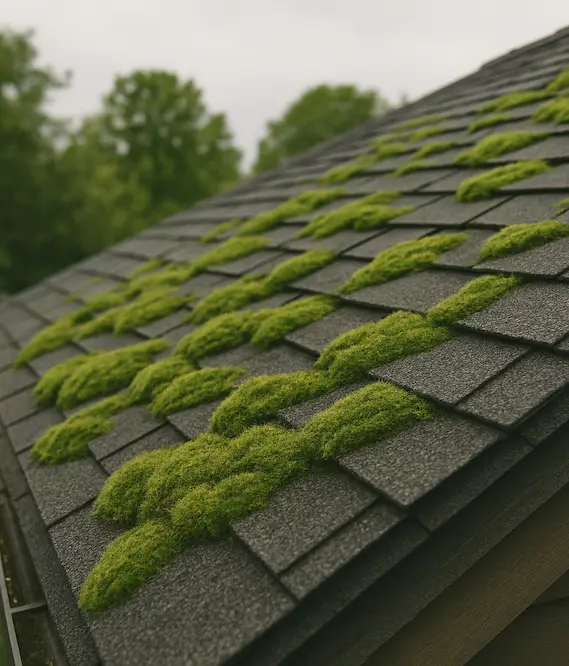
Why? Western Washington has the perfectly damp recipe for moss growth: lots of rain, plenty of overcast days, and shady trees everywhere. Roofs here often stay damp for days, especially on the north-facing side, which gives moss the moisture it loves. We clean roofs in Tumwater, Shelton, and Spanaway all the time and the story is always the same: if there’s tree cover and moisture, there’s moss.
Shade matters more than rain
Everybody blames the rain. But two houses on the same street get the same rain, and one roof is green while the other is clean. The difference is usually a big Douglas fir or maple hanging over one of them.
Oregon State University’s Extension Service says the same thing: moss depends on shade, and it traps needles and dirt that keep the roof wet even longer. Look at your own roof. The moss is probably thickest on the north side and under the branches, where the shingles never fully dry out.
What moss does to shingles
The problem is, moss isn’t just sitting there looking green. Its roots work their way into your shingles, lifting them up and holding moisture underneath. That can lead to rot, leaks, and early roof replacements which no one wants.
The Asphalt Roofing Manufacturers Association, the trade group for the companies that make shingles, describes the same damage: moss makes the front edges of shingles lift or curl. A lifted shingle catches wind. One good November storm and it’s in your yard.
Black streaks are a different thing
Those dark streaks running down a roof are algae. They look bad, but that same manufacturers group says there’s no evidence algae harms asphalt shingles. So streaks are a looks problem. Moss is a roof problem. If you have to pick one to worry about, pick the moss.
The safest way to get it off
Here’s the safest way to deal with it: soft washing. Unlike pressure washing, which can blast shingles apart, soft washing uses low pressure and a cleaning solution that kills moss at the root. It works great for Olympia-area roofs because it’s gentle and long-lasting.
We’re not the only ones who say so. The shingle makers' own cleaning guidance is blunt: never use a pressure washer on an asphalt shingle roof. It strips off the granules, and the granules are what protect the shingle from the sun. Their recommended method is a cleaning solution sprayed on, left to work, then rinsed with low-pressure water. That’s a soft wash.
We also recommend staying off the roof. It might be tempting to get up there with a broom or hose, but it’s risky and usually ends up making the problem worse. Scrubbing knocks granules loose the same way a pressure washer does, and a mossy roof is slick. Let a pro take care of it the right way.
How to slow it down afterward
Moss comes back if nothing changes. A few things help:
- Cut back branches that hang over the roof. Extension experts call this the most effective long-term fix, because more sun means a drier roof.
- Blow needles and leaves off a couple of times a year. A leaf blower works. A stiff broom doesn’t, for the granule reason above.
- Keep the gutters clear so water leaves the roof instead of sitting at the edge.
What about zinc strips? You’ll see them sold as a moss cure. The manufacturers group doesn’t recommend adding them to an existing roof, since fastening them on can cause leaks. If you’re replacing the roof anyway, ask your roofer about algae-resistant shingles instead.
So if you’re seeing moss starting to creep across your roof in Puyallup or Montesano, it’s probably time to do something before it starts causing problems. One soft wash can make a big difference.